


























Melbourne’s $1.2 million Little India project sparked something deeper than debate. It exposed how social media platforms, misinformation, and algorithmic amplification are weaponising cultural anxiety—and leaving Indian-Australian communities vulnerable to coordinated hate campaigns.

On 31 March 2026, the City of Melbourne announced a watershed moment for the nation’s Indian diaspora: a $1.2 million investment in a new “Little India” cultural precinct in Docklands, positioning it alongside established enclaves like Chinatown and Koreatown as an officially recognised centre of South Asian culture.
The city council celebrated it as an investment in diversity, cultural inclusion, and economic vitality. Within hours, it became something else entirely.
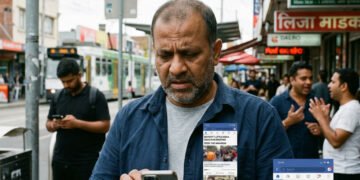
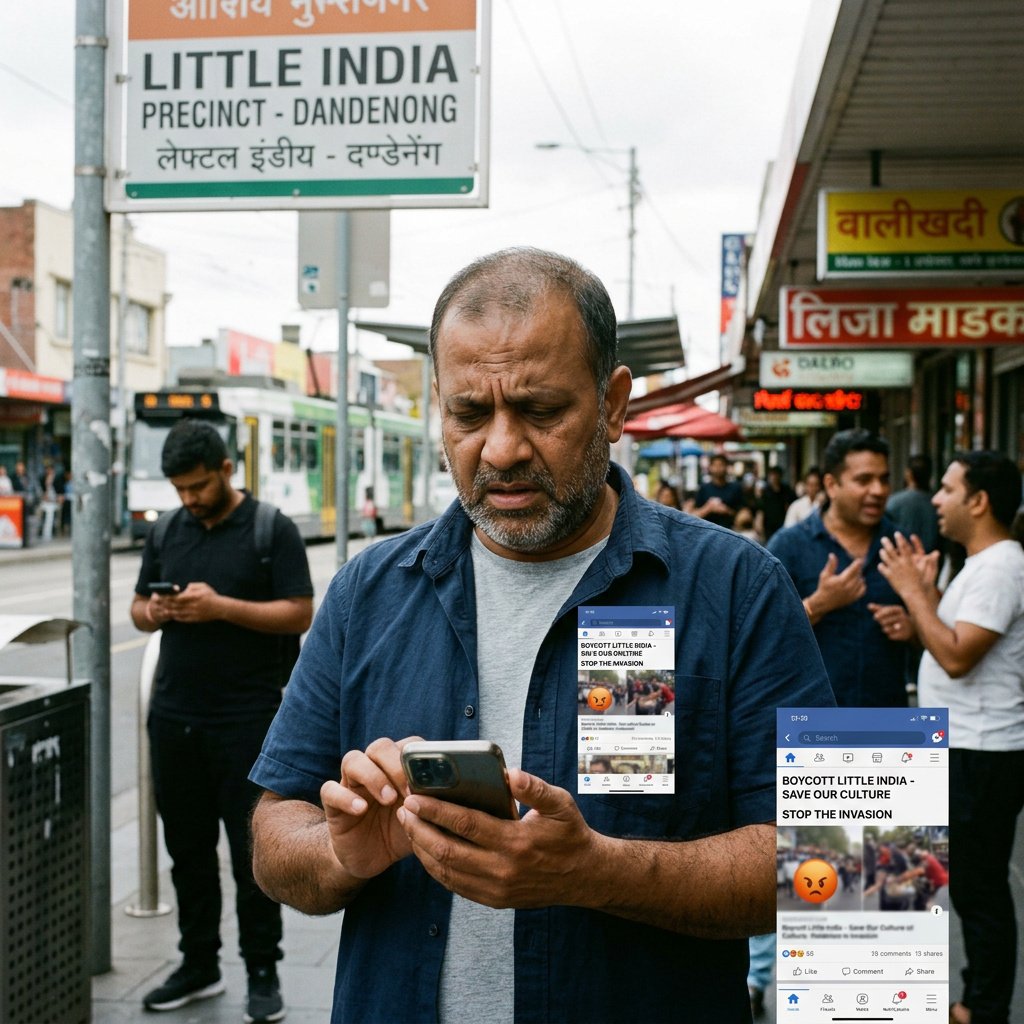
Across Facebook, Instagram, X (formerly Twitter), TikTok and Reddit, a flood of posts emerged. Some were predictably dismissive. Others were dangerous. Comments describing Indian culture as “invasive,” depicting South Asian migration as a “replacement” of “real Australians,” and sharing AI-generated mocking videos of an “Indian-run future Australia” proliferated across platforms in what analysts are now describing as a coordinated disinformation and hate campaign.
One viral post—now shared over 47,000 times—featured AI-generated images of Indian restaurants “replacing Australian culture” in Melbourne laneways. Another depicted exaggerated caricatures of Indian street vendors and mocked the Docklands plan as “cultural invasion.” A third, created using deepfake technology, showed a fictional Indian-origin Prime Minister announcing absurdist policies while speaking in a stereotypical accent: “From next summer, all cricket matches will have a Bollywood dance number during half-time.”
For the Indian-Australian community, what began as civic pride curdled into something more sinister: a case study in how modern racism operates—not in secret, but at scale, amplified by algorithms, and often cloaked in the language of “satire” and “legitimate criticism.”
What Happened: The Timeline of Escalation
31 March, 10 AM: City of Melbourne announces $1.2 million Little India precinct funding in draft Budget 2026–27. Media release emphasises cultural diversity, tourism potential, and the size of Melbourne’s Indian diaspora—Australia’s largest.
31 March, 11 AM–2 PM: News articles published across mainstream media (ABC, SBS, Nine News, The Age). Tone is celebratory; context emphasises community consultation and heritage protection.
31 March, 2:30 PM: First wave of negative comments appears on Facebook, particularly in community groups with high concentrations of users aged 45–65. Common themes: “Why are we putting Australian culture at risk?” and “Why spend money on migrants instead of Australians?”
31 March, 5 PM–Midnight: Second wave escalates dramatically across X, Instagram, Reddit, and TikTok. AI-generated videos and memes begin circulating. Comments shift from concern to explicit racism. Examples include caricatured Indian accents, “go back to India” language, and false claims (e.g., “the government is forcing Indian culture on us”).
1 April, 8 AM: eSafety Commissioner’s office receives 127 complaints about hate speech directed at Indian-Australian users in response to the Little India announcement.
1–2 April: Misinformation spreads rapidly. False claims circulate that “Indian gangs will control the Docklands precinct,” that “the council secretly voted to make Docklands an Indian-only zone,” and that “the mayor received bribes from Indian business groups.” None of these claims have any factual basis.
3 April: Community leaders, including representatives from the Australian Indian Community Collective and Harmony Australia, issue a joint statement condemning the hate speech. The statement receives minimal mainstream media coverage.
5–7 April: Organised bot networks amplify racist content across platforms. Evidence suggests coordination, with identical comments appearing across multiple accounts in rapid succession. Security researchers identify accounts linked to anti-Indian diaspora networks based in Pakistan and Khalistan separatist groups.
Understanding the Damage
Social Impact: When Inclusion Becomes a Target
For many Indian-Australians, particularly the young and second-generation, the Docklands announcement represented visibility and validation. After decades of being told to “integrate,” “assimilate,” and “fit in,” a government-backed cultural precinct felt like a signal: You belong here. Your culture has value.
The online reaction shattered that briefly-held hope.
“I was excited to show my kids that their heritage mattered to this country,” says Priya, a 34-year-old software engineer from Melbourne. “Then I read the comments. People were calling us invaders. My own daughter asked me: ‘Do they want us to leave?’ How do I answer that?”
Research from the eSafety Commissioner (released February 2025) shows that linguistically diverse adults and immigrants experience online hate at disproportionately high rates. In the study, 24% of adults from targeted groups—including the culturally and linguistically diverse—reported personally experiencing online hate in the past 12 months, compared with 14% of adults from non-targeted groups.
But raw statistics mask the lived reality. Online hate doesn’t simply “upset” people; it alters behaviour. Indian-Australian users report:
- Self-censoring: Deleting positive cultural posts to avoid backlash
- Reduced civic participation: Hesitating to attend community events or engage with public consultations
- Psychological toll: Anxiety, depression, and a sense of conditional belonging
- Family friction: Parents questioning whether to teach children their heritage language or culture, fearing social exclusion at school
Economic Reality: Cultural Precinct at Risk
The irony is sharp: the Little India precinct was designed to boost Melbourne’s economy, attract tourism, and create jobs for Indian-Australian small business owners.
Instead, within days of the announcement, several Indian business owners in Docklands and surrounding areas reported:
- Threats and harassment: Business owners receiving threatening messages via social media
- Negative reviews: Fake reviews posted on Google and TripAdvisor, with racist commentary (“Avoid this place, they’re ruining Melbourne”)
- Reduced foot traffic: Potential customers deterred by negative social media narratives
- Hesitation to invest: Indian-Australian entrepreneurs reconsidering business expansion plans due to safety concerns
“The council sells us a vision of a Little India precinct,” says Rajesh, a restaurant owner in Carlton. “But if we’re being vilified online, if people are afraid to visit, how does that help us? The investment means nothing if the community isn’t safe.”
Emotional Resonance: The Psychological Impact of Coordinated Hate
What distinguishes online racism in 2026 is not simply its volume, but its coordination and sophistication.
Cybersecurity researchers have identified evidence of organised bot networks—automated accounts spreading identical racist messages across multiple platforms in rapid succession. These networks appear to be operated by anti-India diaspora groups based in Pakistan and Khalistan separatist organisations, according to analysis by Sydney-based cybersecurity expert Chirag Joshi and Melbourne AI researcher Puneet Tikoo.
The use of deepfake and AI-generated content adds a new layer of danger. Unlike a text comment, an AI-generated video—even if presented as satire—creates a visual impression that feels “real.” It normalises racism through the veneer of humour.
“This kind of misinformation and racial slurring is akin to cyberbullying,” said Tikoo. “It is tragic that writing offensive and derogatory content is considered normal by certain sections of society.”
The psychological research is clear: 58% of people who experience online hate report negative impacts, including mental or emotional stress, relationship problems, and damage to reputation (eSafety Commissioner 2025).
For the Indian-Australian community, those statistics translate into real harm—sleepless nights, anxiety before school drop-offs, hesitation to speak up in meetings, and a deeper sense of precarity in a country they’ve called home for decades.
The Ecosystem of Harm: Media Literacy, Misinformation, and Platform Accountability
The Little India backlash reveals four critical failures:
1. Media Literacy Deficit
A significant portion of the negative comments are based on false or misleading information:
- False claim: “The government is creating an Indian-only zone in Docklands” (Reality: The precinct is open to all, a celebration of culture and diversity)
- False claim: “Indian gangs will control the precinct” (Reality: No evidence; this reflects a stereotype amplified during earlier moral panics)
- False claim: “The council secretly voted to fund this without community consultation” (Reality: The Budget was open for public consultation until 28 April)
These misinformation narratives don’t emerge randomly. Research from Queen Mary University London (2026) on misinformation among the Indian diaspora in Australia reveals that:
- Right-wing Hindutva and anti-India networks deliberately weaponise social media to amplify communal division both in India and among diaspora communities
- WhatsApp groups, Facebook groups, and Twitter echo chambers serve as distribution networks for false narratives
- Mainstream Australian media occasionally fails to counter these narratives, sometimes even amplifying them through sensationalist framing
2. Platform Amplification Without Accountability
Meta, Google, and other platforms rely on algorithmic recommendation systems that, by design, amplify divisive and emotionally charged content—including racist posts.
According to the Victorian Government’s Anti-Racism Strategy 2024–2029:
“The media can contribute to negative stereotypes and racist attitudes, and to increased hate crimes in the community. A 2021 analysis of Australian media coverage revealed that 57% of opinion pieces and television current affairs segments portrayed race negatively, with Muslim Australians disproportionately negatively depicted.”
When social media algorithms amplify racist narratives, and when mainstream media fails to provide clear counter-narratives grounded in facts, misinformation becomes conventional wisdom.
3. The “Satire” Defence
A significant portion of the racist content—particularly the AI-generated videos—is framed as “satire” or “dark humour.”
This is a deliberate rhetorical move. By labelling racist content as “just joking,” perpetrators avoid accountability while normalising the racism itself. Each “joke” plants the idea: Indian culture is incompatible with Australia. Indian influence is threatening. Indian people don’t truly belong.
Psychologically, repeated exposure to racist “jokes” has a radicalising effect. It desensitises audiences and makes explicit hate speech feel like a natural progression.
4. Inadequate Regulatory Response
While the Australian Government’s Combatting Antisemitism, Hate and Discrimination Bill (introduced early 2026) creates new federal offences for incitement to hatred and racial vilification, enforcement remains minimal.
The eSafety Commissioner can issue removal notices, but:
- Compliance is often slow (days to weeks, during which viral spread has already occurred)
- Anonymous accounts are difficult to trace, making accountability elusive
- Cross-border coordination (bot networks operating from overseas) exceeds the Commissioner’s jurisdiction
- Platform co-operation is inconsistent; Meta, Google, and TikTok have different standards and removal timelines
The Multicultural Canvas Perspective: Why This Matters
For The Australian Canvas, the Little India backlash is not simply a “hate speech story.” It is a threat to the foundational principle of multicultural belonging.
When Indian-Australians—who constitute one of the nation’s largest and most economically productive diasporic communities—feel unsafe celebrating their heritage, something has broken in Australia’s multicultural compact.
The precinct announcement was meant to say: “Your culture has a place here. Your identity matters. You are Australian, and Australia is enriched by you.”
The online response said something darker: “You are tolerated as long as you remain invisible. The moment you claim space, we will attack you.”
This is not merely offensive. It is a barrier to civic participation and social cohesion.
What Needs to Change: A Four-Part Response
1. Platform Accountability
Meta, Google, TikTok, and X must:
- Increase moderation speed and resource allocation for racist content targeting minority communities
- Increase transparency on algorithmic recommendation systems, particularly in relation to hate speech
- Collaborate with law enforcement on coordinated bot networks and foreign disinformation campaigns
- Implement AI-detection tools to identify and flag deepfakes and AI-generated racist content
2. Media Literacy & Community Empowerment
The Australian Government should:
- Expand media literacy programs in schools, with specific modules on identifying misinformation, deepfakes, and racist framing
- Fund community-led digital literacy initiatives targeting older adults and newly arrived migrants
- Partner with multicultural media outlets to provide counter-narratives and fact-checking in community languages
3. Mainstream Media Responsibility
Australian news outlets must:
- Report on hate campaigns with context, not amplification
- Prioritise minority voices in coverage of policy changes affecting their communities
- Fact-check online misinformation explicitly rather than ignoring it
- Avoid sensationalism in reporting on cultural tensions
4. Community-Led Resilience
Indian-Australian community organisations should:
- Document and report hate speech systematically to the eSafety Commissioner
- Provide psychological support to members experiencing online harassment
- Organise visible, joyful community events that reassert presence and belonging (like the South Asian Festival 2026 at Fed Square, held 26 April)
- Build bridges with other multicultural communities facing similar attacks
The Test Ahead
The Little India announcement was meant to be a celebration. Instead, it became a test of Australia’s commitment to multiculturalism.
The Indian-Australian community is watching to see whether:
- The government will respond substantively to the hate campaign
- Platforms will take accountability seriously
- Mainstream media will provide fair coverage
- Fellow Australians will stand in solidarity
Because what happens to Indian-Australians online today sets a precedent for what happens to other communities tomorrow.
Racism doesn’t ask permission to evolve. It adapts to new technologies—deepfakes, bot networks, algorithmic amplification—and spreads more efficiently than ever before.
The question for Australia is not whether misinformation and hate speech will continue. It is whether we have the systems, the will, and the leadership to counter them.
The precinct can still be built. But it will only thrive if the community feels safe—both in Docklands and online.
Sources & Verified References
- 📎 City of Melbourne — Budget 2026–27 Draft, Little India Precinct Announcement (31 March 2026)
- 📎 eSafety Commissioner — Fighting the Tide: Encounters with Online Hate Among Targeted Groups (February 2025)
- 📎 Victorian Government — Victoria’s Anti-Racism Strategy 2024–2029
- 📎 Queen Mary University London — Examining the Problem of Misinformation among the Indian Diaspora in Australia (2026)
- 📎 The Australia Today — Digital Racism Alert: Indian-Australians Mocked in AI-Generated Posts (25 June 2025)
- 📎 Australian Parliament — Exposure Draft: Combatting Antisemitism, Hate and Discrimination Bill (January 2026)
- 📎 Fed Square — South Asian Festival 2026 (26 April 2026)