



































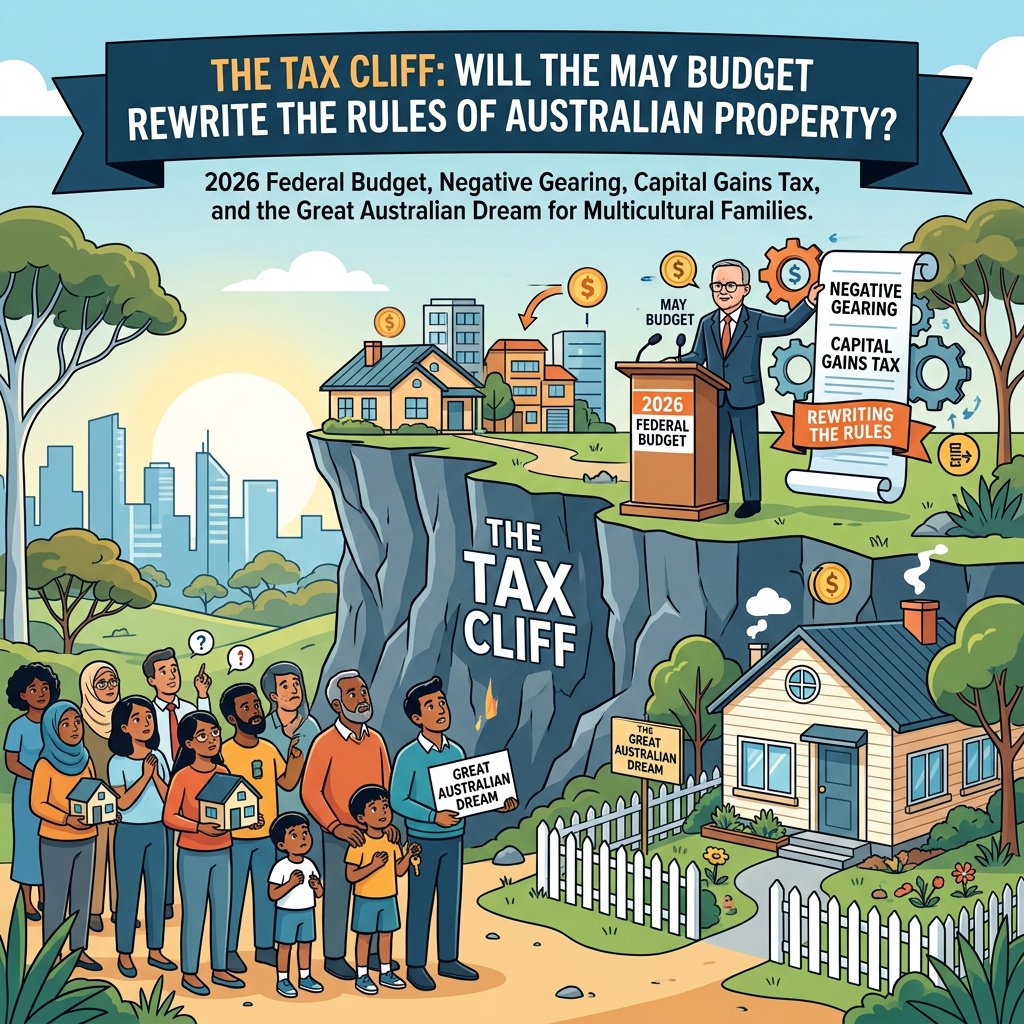
With the 2026 Federal Budget just weeks away, the Albanese Government is weighing a historic gamble on negative gearing and capital gains tax—reform that could reshape the “Great Australian Dream” for millions of multicultural families.

For decades, the phrase “negative gearing” has been more than a tax setting in Australia; it has been a cultural institution. For many migrant families arriving in the 1980s, 90s, and 2000s, property was the “safe bet”—a tangible path to wealth in a new country that didn’t require a sophisticated understanding of the ASX or complex superannuation structures.
But today, on 28 April 2026, that institution is standing at its most precarious crossroads in a generation.
As the nation prepares for the May Budget, Treasury is reportedly putting the final touches on modelling that could fundamentally alter how Australians invest. With Labor holding a commanding 94-seat majority since the 2025 election, the political “safety rail” that previously prevented reform has vanished. The question is no longer whether the government can change the rules, but whether it will.
The Proposals: What’s on the Treasurer’s Desk?
While Prime Minister Anthony Albanese and Treasurer Jim Chalmers have maintained a cautious public stance, industry leaks and Treasury briefings confirm that two specific levers are being tested:
- The “Two-Property Cap”: A proposal to limit negative gearing to a maximum of two investment properties. Losses from a third or fourth property would be “ring-fenced,” meaning they could only be offset against rental income, not against a primary salary.
- The CGT Discount Trim: A reduction of the Capital Gains Tax (CGT) discount from 50% to 33% (or potentially 25%, as suggested by Senator David Pocock). This would mean that when an investor sells a property, a larger portion of the profit would be subject to tax.
According to analysis by Australian Property Experts, the goal is not to crash the market—modelling suggests a modest cooling effect of 1% to 2%—but to tilt the scales back toward first-home buyers.
1. Social Impact: A Tale of Two Generations
In suburbs like Parramatta, Box Hill, and Sunnybank, the debate isn’t just about tax—it’s about family legacy.
For the “established” multicultural community—those who arrived decades ago and built portfolios of three or four townhouses—these changes feel like a moving of the goalposts. Conversely, for their children and newly arrived migrants facing a median house price that has outpaced wage growth by a factor of three, the current system feels like a closed door.
“My parents used negative gearing to put us through university,” says Anika, a 28-year-old pharmacist in Sydney. “But now, even with my salary, I can’t outbid an investor for a basic two-bedroom flat. We are a community divided by when we got into the market.”
2. Economic Reality: Supply vs. Subsidy
The economic debate is a clash of titans. Peak bodies like the Housing Industry Association (HIA) and Master Builders Australia have issued a joint warning: slashing these tax breaks could “stifle housing supply.” Their modelling suggests reform could cost the economy $3 billion and result in 46,000 fewer housing starts over five years.
On the other side, the Grattan Institute and ACOSS argue that the current system effectively subsidies “wealth creation for the top 10%” at the expense of the taxpayer. They argue that by “grandfathering” existing properties—ensuring current owners aren’t hit by retrospective changes—the government can transition to a fairer system without triggering a fire sale.
3. Emotional Resonance: The “Mum and Dad” Anxiety
There is a profound emotional weight to property in multicultural Australia. Unlike many Western European cultures where long-term renting is the norm, many South Asian, East Asian, and Middle Eastern communities view homeownership as the ultimate marker of “making it” in Australia.
The fear among “mum and dad” investors isn’t just about the money; it’s about the loss of a predictable future. “We don’t have big corporate pensions,” explains Mr. Nguyen, a small business owner. “Our properties are our pension. If they change the tax, they change our retirement.”
The Political Landscape: A Landslide Mandate
The political reality of 2026 is vastly different from 2019, when Labor’s “Big Target” strategy on housing tax failed. After the May 2025 landslide, the Albanese Government has the numbers to legislate without needing the Greens or the “Teal” independents.
However, pressure from the crossbench remains a factor. Independent Senator David Pocock and North Sydney MP Allegra Spender have both released white papers calling for the CGT discount to be reduced and for negative gearing to be restricted to newly built homes to incentivise supply.
What Happens Next?
All eyes are now on the second Tuesday in May. If the Treasurer includes these reforms in the Budget, he will likely include a “Grandfathering Clause”—meaning any property you own before the start date (likely 1 July 2026) will remain under the old rules.
For those looking to enter the market or expand a portfolio, the next few weeks are a period of high-stakes “wait and see.”
Sources & Verified References
- 📎 Accounting Times (March 2026): David Pocock backs major reforms for CGT, negative gearing.
- 📎 Australian Property Experts (April 2026): Negative Gearing Changes 2026: What Investors Must Know.
- 📎 Smart Property Investment (March 2026): Investor exodus feared as CGT, negative gearing cuts loom.
- 📎 ACOSS Policy Paper (2025/26): Homes for living, not wealth creation.
- 📎 Propkt Analysis: Where Things Stand in 2026: Treasury Modelling and the May Budget.