




































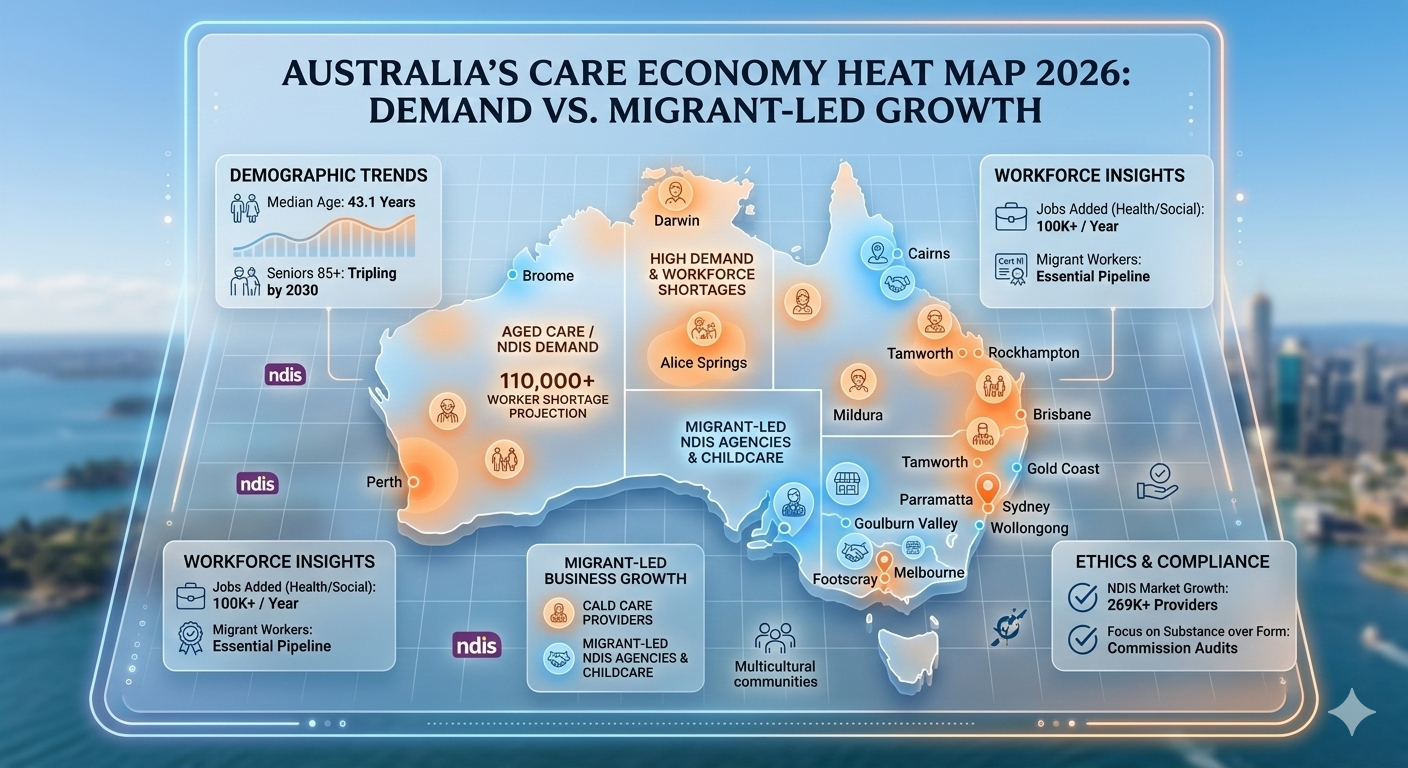
Demand is soaring and the workforce is stretched to breaking point—now, a new wave of multicultural leaders is turning a national crisis into a business revolution.
Australia’s care economy is no longer just a social safety net; in 2026, it is the nation’s most aggressive growth sector. With an ageing population and a maturing NDIS, the business of “looking after people” has become a magnet for investment. But as billions flow into the sector, the conversation is shifting from simple capacity to a high-stakes test of ethics and workforce dignity.

We are currently in the middle of a demographic pincer movement. According to the Parliament of Australia’s 2026 workforce study, our median age is climbing toward 43, and the population of those aged 85 and over is set to triple. This isn’t just a “future problem”—it’s a $51.8 billion market reality that is straining under a projected shortfall of 110,000 direct care workers by 2030.
But where some see a crisis, others see a mission. A new generation of migrant-led providers is stepping into the gap, bringing a mix of global business acumen and a deeply cultural approach to care that is reshaping what “quality” looks like on the ground.
The Rise of the Migrant-Led Provider
In 2026, multicultural entrepreneurs aren’t just the backbone of the workforce; they are increasingly the ones at the boardroom table. From western Sydney to the suburbs of Perth, migrant-led aged care and NDIS agencies are booming. These founders often start with a unique competitive advantage: they understand the specific linguistic and cultural needs of Australia’s diverse ageing population.
Data from Jobs and Skills Australia shows that the Health Care and Social Assistance sector saw the largest employment jump in the last year, adding over 100,000 jobs. A significant portion of this growth is driven by providers who specialise in culturally and linguistically diverse (CALD) care. For many Greek, Vietnamese, or Arabic-speaking seniors, having a provider who understands their “mother tongue” isn’t a luxury—it’s a fundamental requirement for dignity.
The Ethics Wall: Compliance is the New Cool
However, with rapid growth comes rapid scrutiny. The “gold rush” era of the NDIS—where unregistered providers could operate with minimal oversight—is being hit by a massive regulatory hammer. As of February 2026, the NDIS Quality and Safeguards Commission has ramped up its strategic roadmap, focusing on “substance over form.”
The market is currently saturated with over 269,000 active providers. To survive the 2026 “trust test,” businesses are having to professionalise. Ethics is no longer a footnote in a brochure; it’s a survival strategy.
“If you run a care business in 2026, growth has to be measured, not reactive,” notes recent industry analysis. This means moving away from “agency-heavy” models that churn through staff and toward “values-driven leadership.” Providers who fail to implement rigorous incident reporting or fail to keep staff credentials current are finding themselves on the wrong side of the ACCC and NDIS Commission audits.
The Workforce Pressure Cooker
The elephant in the room remains the workforce. While the Fair Work Commission has delivered significant wins—including a further wage increase for nurses and direct care staff scheduled for August 2026—the pressure on the frontline remains immense.
- Wage Increases: Many Cert III roles now align with a “Caring Skills Benchmark” of approximately $1,270 per week, a move aimed at making the sector more competitive with retail and hospitality.
- Burnout is Real: Despite the pay rise, attrition remains high. The 2026 Aged Care Provider Workforce Survey is currently gathering data to address “emotional fatigue” and “limited career progression.”
- The PR Path: For the one-third of care workers born overseas, the sector is more than a job; it’s a stable pathway to permanent residency. New “Essential Skills” visa pathways are being championed to reduce the 12-month red-tape delays that have historically choked the supply of workers.
The Human-Centred Values of 2026
What defines success in the care economy today? It’s the shift from “consumption” to “connection.” The most successful providers in 2026 are those who treat their staff as their most valuable asset, not a line-item expense.
In the era of “greenwashing” and “social-washing,” the care sector is under a magnifying glass. Investors are now looking for “impact” that can be proven—not just by the numbers, but by the lived experience of the participants. For the young Australian reader looking for a career with purpose, or the entrepreneur looking for a market with heart, the care economy is where the real stories are being written.
As we move forward, the goal is a system that doesn’t just “manage” ageing or disability, but celebrates the diversity and humanity of every person involved.
Sources: * Parliament of Australia: Sustaining our aged care workforce (2026)