
















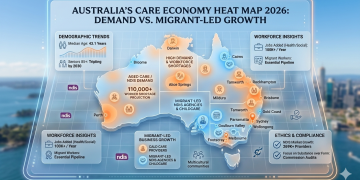




















By the first quarter of 2026, Australia’s labour market has bifurcated into a “dual-speed” reality. On one hand, the National Skills Priority List, released by Jobs and Skills Australia, indicates that nearly 40% of occupations are experiencing a “persistent shortage.” The most acute gaps remain in the care economy—healthcare, aged care, and early childhood education—and the construction sector, which is under immense pressure to deliver the government’s 1.2 million homes target.

According to data released by the Committee for Economic Development of Australia (CEDA), the aged care sector alone requires an additional 8,000 workers annually just to meet basic mandated care minutes. Similarly, the Master Builders Association reports a shortfall of 90,000 tradespeople required to fulfill the “Housing Australia” pipeline. These are not merely economic figures; they represent a fundamental strain on the social fabric of the nation. When there are not enough nurses in regional hospitals or educators in local childcare centres, the quality of life for all Australians is impacted.
The Migration Fix: Precision over Volume
To address these gaps, the 2025–2026 Permanent Migration Program has been recalibrated to prioritize “Core Skills.” The 2026 Migration Strategy focuses on the Specialist Skills Pathway and the Core Skills Pathway, which are designed to fast-track visas for individuals in sectors with verified shortages. Unlike previous broad-based migration intakes, the 2026 model uses “Real-Time Labour Market Data” to adjust visa invitations monthly.
This precision is a direct response to the “fairness debate.” Critics and union bodies, including the ACTU, have voiced concerns that an over-reliance on migration can suppress local wage growth and disincentivize domestic training. In response, the government has introduced the 2026 Workforce Integration Guarantee, which mandates that for every skilled visa granted in the construction sector, there must be a corresponding investment in local apprenticeships. This policy seeks to answer the brewing public question: “Where are the jobs actually going?” By ensuring that migration complements rather than replaces local labour, the strategy aims to maintain social license for a high-migration program during a cost-of-living crisis.
The Fairness Debate: Housing and Cost-of-Living Pressure
The tension between skilled migration and local job anxiety is inextricably linked to the housing market. As of March 2026, the national rental vacancy rate remains below 1.5% in most capital cities. This has led to a growing public sentiment that while migration might fix a workforce shortage in the “care economy,” it simultaneously exacerbates the “housing shortage.”
Framing migration as a matter of public concern requires acknowledging this “Catch-22.” Without migrant tradespeople, the houses cannot be built; yet, when the tradespeople arrive, they also require housing. According to a report by the Australian Housing and Urban Research Institute (AHURI), the solution lies in “Essential Worker Housing” initiatives, where a percentage of new developments are reserved specifically for those in the care and construction workforces. This transparency in planning is essential for social cohesion, as it demonstrates that the migration intake is being managed with infrastructure capacity in mind.
The Care Workforce: A Cultural and Economic Pillar
The “Care Workforce Shortage” is perhaps the most emotionally resonant aspect of this debate. In early childhood education and aged care, the reliance on migrant workers has historically been high. In 2026, the focus has shifted toward “Professionalizing the Sector.” Recent wage increases for aged care and childcare workers—first introduced in 2024 and 2025—are finally showing results in local recruitment.
However, the Productivity Commission’s 2026 Progress Report confirms that domestic supply still cannot keep pace with the needs of an aging population. Skilled migration in the care sector is now being framed not as a “cheap labour” fix, but as a “Global Talent Exchange.” Many of our new healthcare professionals bring specialized experience from diverse international health systems, enriching the Australian healthcare landscape. The “New Australian” nurse or educator is increasingly seen as the backbone of our community resilience, filling roles that are essential for the survival of regional towns.
Accountability: Protecting Local Opportunities
To ensure accountability, the 2026 policy framework includes stricter “Labour Market Testing” (LMT). Employers must now provide transparent evidence that they have attempted to recruit locally at a fair market wage before turning to the Skilled Employer Sponsored Regional (Subclass 494) visa.
Furthermore, the Jobs and Skills Australia 2026 Outlook provides a public dashboard where citizens can track “Skills Matches.” This transparency is designed to mitigate misinformation and show that migration is being targeted at the “high-end” of the skills spectrum. It confirms that the vast majority of visas are going to specialized roles—such as registered nurses, site supervisors, and early childhood teachers—rather than entry-level positions that could be filled by the local workforce.
Conclusion: A Resilient Partnership
The 2026 workforce strategy is a testament to the complexity of a modern, multicultural nation. Australia is attempting to build a system where the “New Australian” and the “Local Tradie” work side-by-side to solve the nation’s most pressing challenges.
By moving away from sensationalist rhetoric and toward fact-based, transparent policy, the nation is slowly bridging the gap between migration and local opportunity. The goal is a workforce that is as diverse as the Australian canvas itself—resilient, skilled, and fairly rewarded for the essential work of caring for and building our future.
Verified Sources and Links
- Jobs and Skills Australia: 2026 Skills Priority List and Labour Market Outlook. jobsandskills.gov.au – Skills Priority
- Department of Home Affairs: The 2026 Migration Strategy – Core Skills and Specialist Pathways. immi.homeaffairs.gov.au – Migration Strategy
- CEDA (Committee for Economic Development of Australia): Duty of Care: Meeting the Aged Care Workforce Challenge (2026 Update). ceda.com.au – Aged Care Research
- AHURI (Australian Housing and Urban Research Institute): Housing and Migration: Managing the 2026 Infrastructure Gap. ahuri.edu.au – Migration and Housing
- Productivity Commission: The Care Economy: 2026 Performance and Future Demand. pc.gov.au – Care Economy