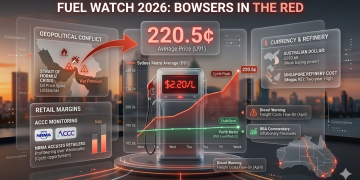
































For the Australian household, the “hip-pocket” reality of 2026 just got a lot more expensive. Over the last 48 hours, petrol stations across the eastern seaboard have seen a dramatic surge in prices, with many motorists waking up to find regular unleaded has jumped by as much as 25 cents per litre overnight.

As the conflict in the Middle East disrupts global shipping lanes, the Australian bowser has become a political and economic flashpoint. But while the war is a factor, consumer advocates warn that something more opportunistic is also at play.
The City-by-City Sting
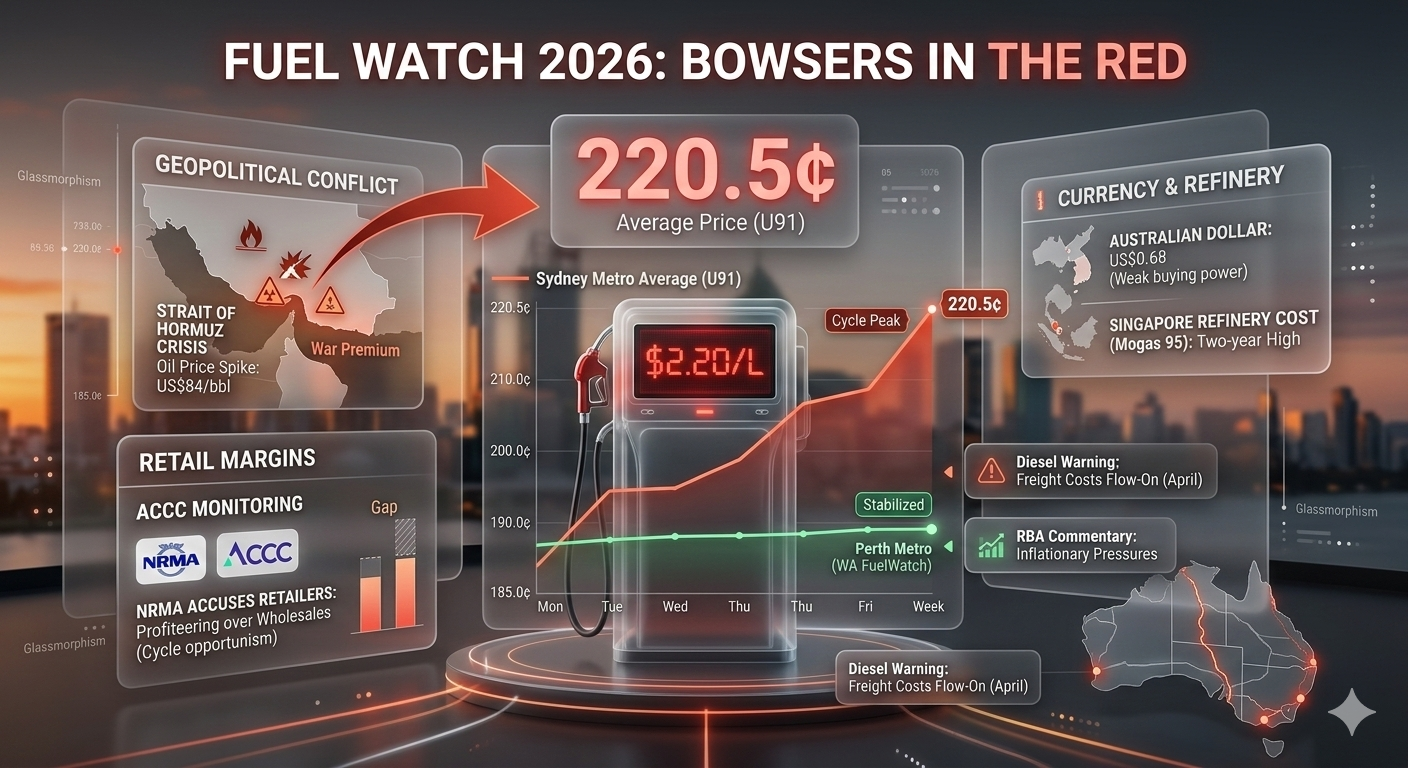
The pain at the pump is not being felt equally. While Sydney, Melbourne, and Brisbane are currently trapped at the high point of their regular price cycles, Adelaide and Perth have remained relatively competitive—for now.
| City | Average Price (U91) | Weekly Trend | Status |
| Sydney | 209.5¢ | +24.0¢ | Cycle Peak |
| Brisbane | 210.2¢ | +25.0¢ | Cycle Peak |
| Melbourne | 207.7¢ | +21.0¢ | Cycle Peak |
| Adelaide | 185.0¢ | -2.0¢ | Falling |
| Perth | 189.1¢ | +1.5¢ | Stable |
Export to Sheets
The ‘War Premium’: Why are prices rising?
There are three primary gears driving this spike, and they are moving faster than usual:
- The Strait of Hormuz Crisis: Roughly 20% of the world’s oil flows through this narrow passage between Iran and Oman. Recent military strikes have forced Brent Crude oil prices above US$80 per barrel. Analysts at Westpac and Oxford Economics warn that if this chokepoint remains disrupted, we could see petrol surge toward $2.50 or higher by late March.
- The Seven-Day Delay: Historically, it takes 7 to 10 days for international oil price movements to hit Australian pumps. However, the NRMA has accused retailers of “using the conflict as an excuse” to jack up margins prematurely, noting that wholesale costs have only risen by about 10 cents while retail prices jumped double that amount.
- Currency & Refineries: The Australian dollar is currently hovering around US$0.68, meaning our buying power for imported fuel remains weak. Coupled with high demand from Asian refineries in Singapore and South Korea, the baseline cost for Australian “Mogas 95” (refined petrol) is at a two-year high.
The Politics of the Pump
Treasurer Jim Chalmers has formally requested the ACCC to step up its surveillance of the fuel market, warning retailers not to “opportunistically” use the war to gouge customers.
“Unfolding events should not be used as an excuse to rip the community off,” Chalmers stated this week. Meanwhile, Energy Minister Chris Bowen has urged Australians to avoid “panic buying,” noting that the government’s minimum stockholding obligation currently secures 36 days of petrol and 34 days of diesel on-shore.
Pro Tip: How to Beat the Peak
Even in a “red” market, you don’t have to pay the highest price.
- Shop the Fringe: NRMA data shows that even when half of Sydney’s stations are at $2.20, about 12% of stations are still selling below $1.90.
- App it Out: Use the My NRMA, FuelCheck (NSW), or FuelWatch (WA) apps to find the “laggards”—the smaller or independent stations that haven’t updated their prices to match the big chains yet.
- The Diesel Warning: For transport and regional business owners, diesel is the bigger worry. Wholesale diesel spiked by 24% this week alone, which experts warn will inevitably flow into higher grocery and freight costs by April.
Sources: