











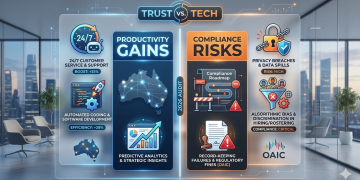



















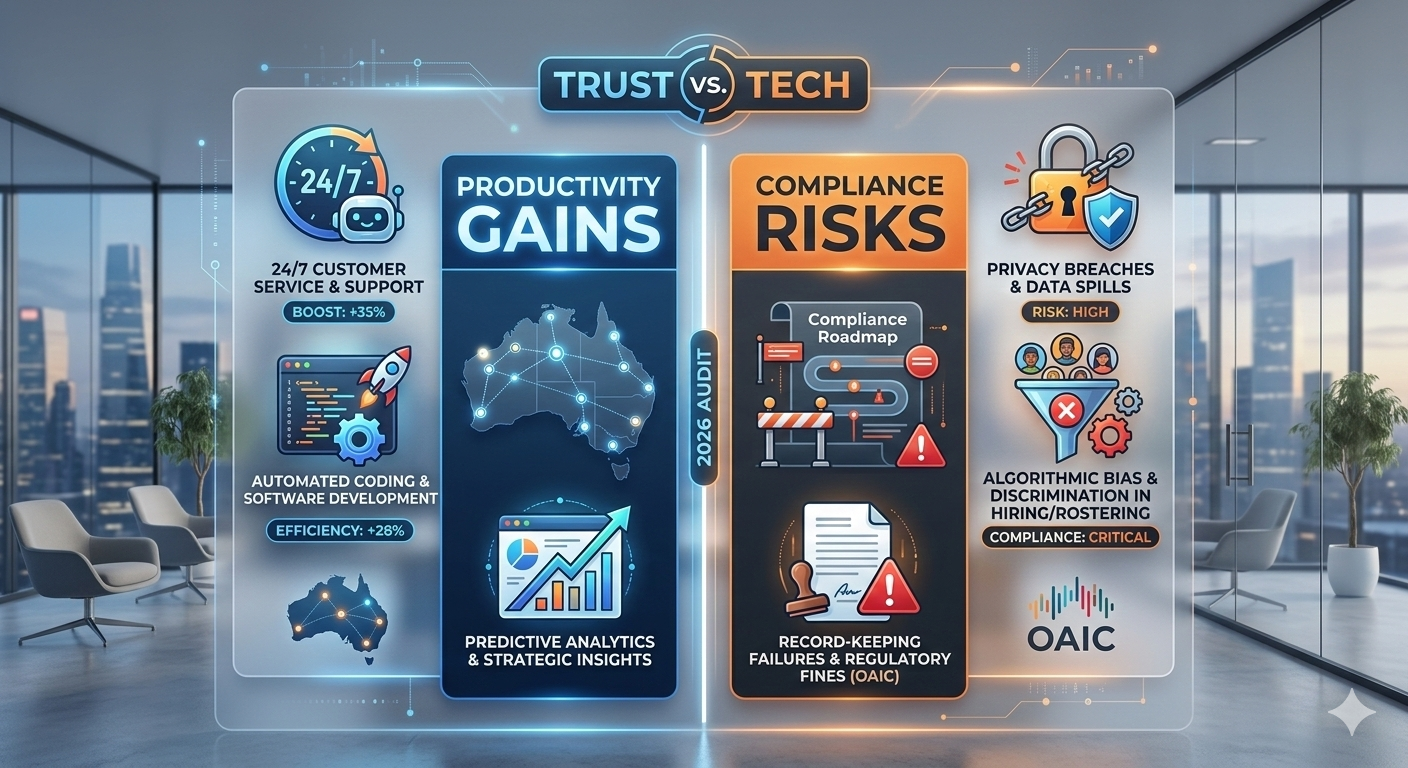
The “experimentation phase” of artificial intelligence is over for corporate Australia. In 2026, AI is no longer a shiny new toy; it’s the engine room. Whether it’s an automated bot handling customer inquiries at 2:00 AM or a smart algorithm sorting through hundreds of resumes in seconds, small-to-medium enterprises (SMEs) are leaning on the tech to survive a tight labor market and skyrocketing operational costs.

But as the bots move from the “nice-to-have” pile into core operations, they are hitting a massive wall of scrutiny. From the privacy watchdog (OAIC) to the nation’s cyber security experts, the message to business owners is clear: if your AI makes a mistake, you own the consequences.
The Tipping Point: 80% and Climbing
AI adoption has reached a fever pitch. Recent industry surveys show that over 80% of Australian small businesses are now either using or actively planning to integrate AI into their daily grind. In 2025, we were still asking if it worked; in 2026, we’re asking how to keep it from breaking the law.
The shift is most dramatic in professional services. 71% of small accounting firms have now adopted AI tools to handle everything from automated document processing to predictive cash flow forecasting. It’s a survival tactic that allows a boutique firm of three people to punch with the weight of a multinational—but it’s also creating a new category of “invisible” risk.
The OAIC ‘Privacy Sweep’: No More Hiding
If you think your small business is too small for the regulator’s radar, think again. In January 2026, the Office of the Australian Information Commissioner (OAIC) launched its first-ever “privacy compliance sweep.”
The watchdog is currently scrutinizing roughly 60 organizations across high-touch sectors like real estate, retail, and pharmacies. Their focus? Transparency. Under new rules (APP 1.7) coming into full effect on December 10, 2026, businesses must be explicitly clear in their privacy policies about how they use personal data in “automated decision-making.”+1
If you use AI to decide who gets a rental property, who qualifies for a loan, or even which staff get the best shifts, you are legally required to show your work. Failing the test can result in infringement notices of up to $66,000 per breach—a “warning siren” that many SMEs are only just starting to hear.
The ‘Shadow AI’ Menace
The biggest threat to your business might not be the AI you know you’re using—it’s the “Shadow AI” your staff are using in secret.
Research suggests that nearly all employees have experimented with unsanctioned apps to speed up their work. Think of a marketing coordinator uploading a sensitive client list into a public, free AI tool to “brainstorm ideas,” or a junior lawyer using a bot to summarize a confidential brief.
The Australian Signals Directorate (ASD) has warned that this is a “data spill” waiting to happen. Once you upload that data into a public model, you lose control. In 2026, “I didn’t know they were using it” is no longer a valid legal defense.
Bias and the ‘Hallucination’ Trap
The era of blind trust in AI outputs is officially dead. 2025 was littered with cautionary tales—like the Sydney real estate agency that falsely advertised a property near schools that didn’t exist because their AI “hallucinated” the map.
Beyond simple errors, algorithmic bias is the new legal frontier. AI models can inadvertently bake in historical discrimination, leading to “biased” hiring or customer service. If your AI filters out candidates based on data that correlates with race or age, your business is on the hook for a discrimination claim.+1
The 2026 gold standard for SMEs is “Human-in-the-Loop” governance. This means no AI output—whether it’s a social media post, a legal document, or a roster—should leave the building without a human checking it for authenticity and accuracy.
3 Ways to Protect Your Biz in 2026
Success in the AI era isn’t about the best software; it’s about the best guardrails. Here’s what the experts at cyber.gov.au recommend:
- Establish an AI Use Policy: Clearly define which tools are allowed and, more importantly, what data (names, health info, financial records) is strictly forbidden from being uploaded.
- Audit Your Privacy Policy Now: Don’t wait for the December deadline. Update your terms to reflect your AI usage and ensure your customers know they have a right to human oversight.
- Train Your Team on ‘Prompt Literacy’: Teaching staff how to use AI responsibly is the best defense against hallucinations and data leaks.
The Verdict: Productivity is a Privilege
AI offers a “fair go” to small businesses, allowing them to scale with unprecedented speed. But in 2026, that productivity boost is a privilege, not a right. The winners this year won’t just be the businesses with the smartest bots—they’ll be the ones that stayed human enough to keep their customers’ trust.
Sources: